ICLR 2025 Procedure planning from visual endpoints
Masked Temporal Interpolation Diffusion
for Procedure Planning in Instructional Videos
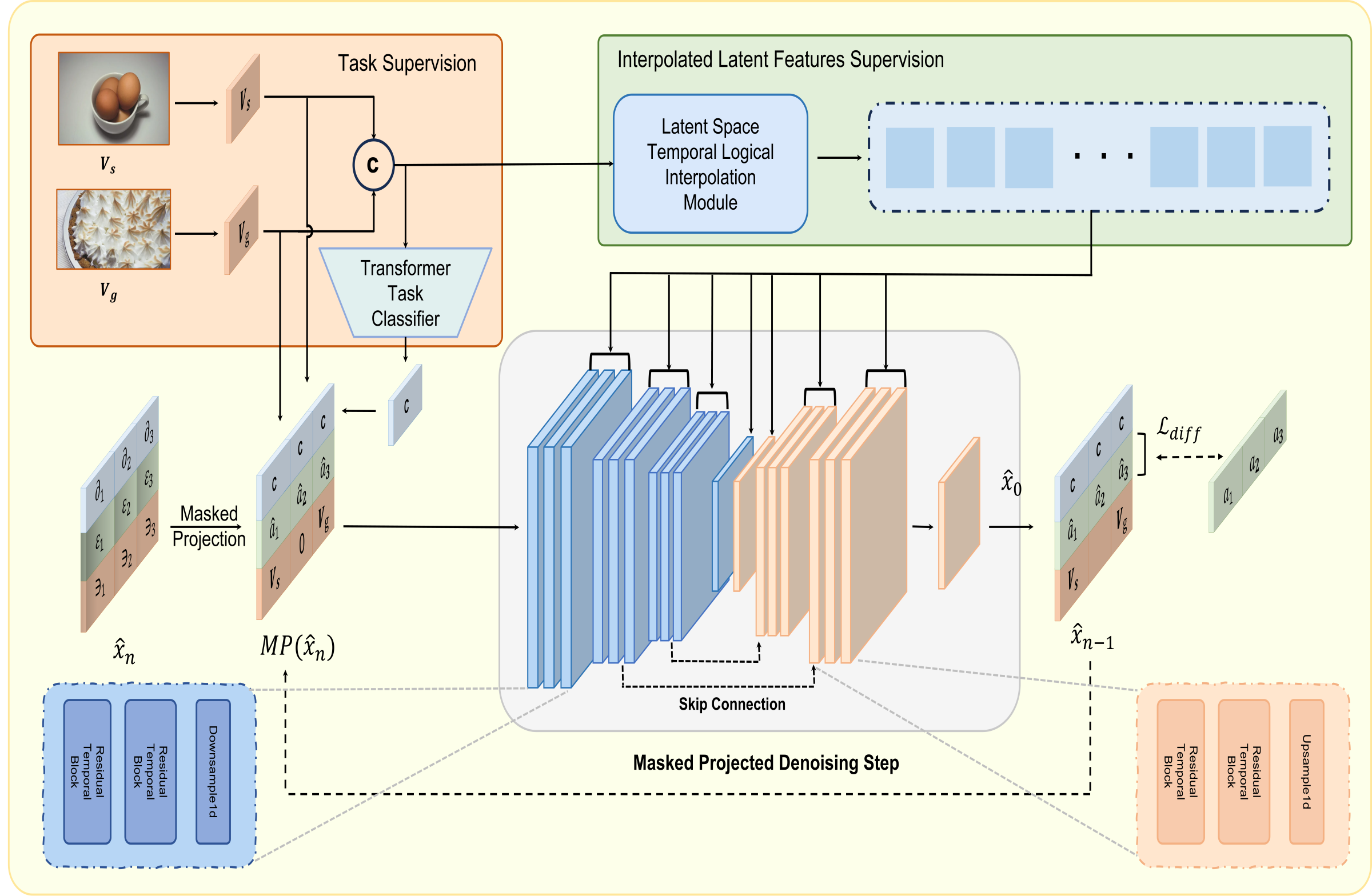
MTID learns latent visual mid-state guidance between a start and goal observation,
then conditions a diffusion planner to predict the intervening discrete action sequence.
1 Harbin Institute of Technology, Weihai2 Key Laboratory of Intelligent Information Processing, Institute of Computing Technology, Chinese Academy of Sciences
* Corresponding authors
Model output: dataset-defined action labels, not generated video frames.
No annotated intermediate visual states are required.
Open full resolution ↗MTID overview. Endpoint observations condition task prediction and latent interpolation.
The task mask restricts action-noise initialization before DDIM denoising predicts the full sequence.
Problem & insight
Reasoning through what the camera never shows.
Procedure planning must infer the discrete actions connecting a visual start state
Vs to a goal state Vg, even though every state in between is unobserved.
01 · Prior supervision
Useful semantics, limited visual detail
Earlier approaches often construct intermediate guidance from task labels, events,
graphs, or language. These signals help identify what should happen, but describe less
of the visual evolution between the endpoints.
02 · MTID
Visual-level guidance in latent space
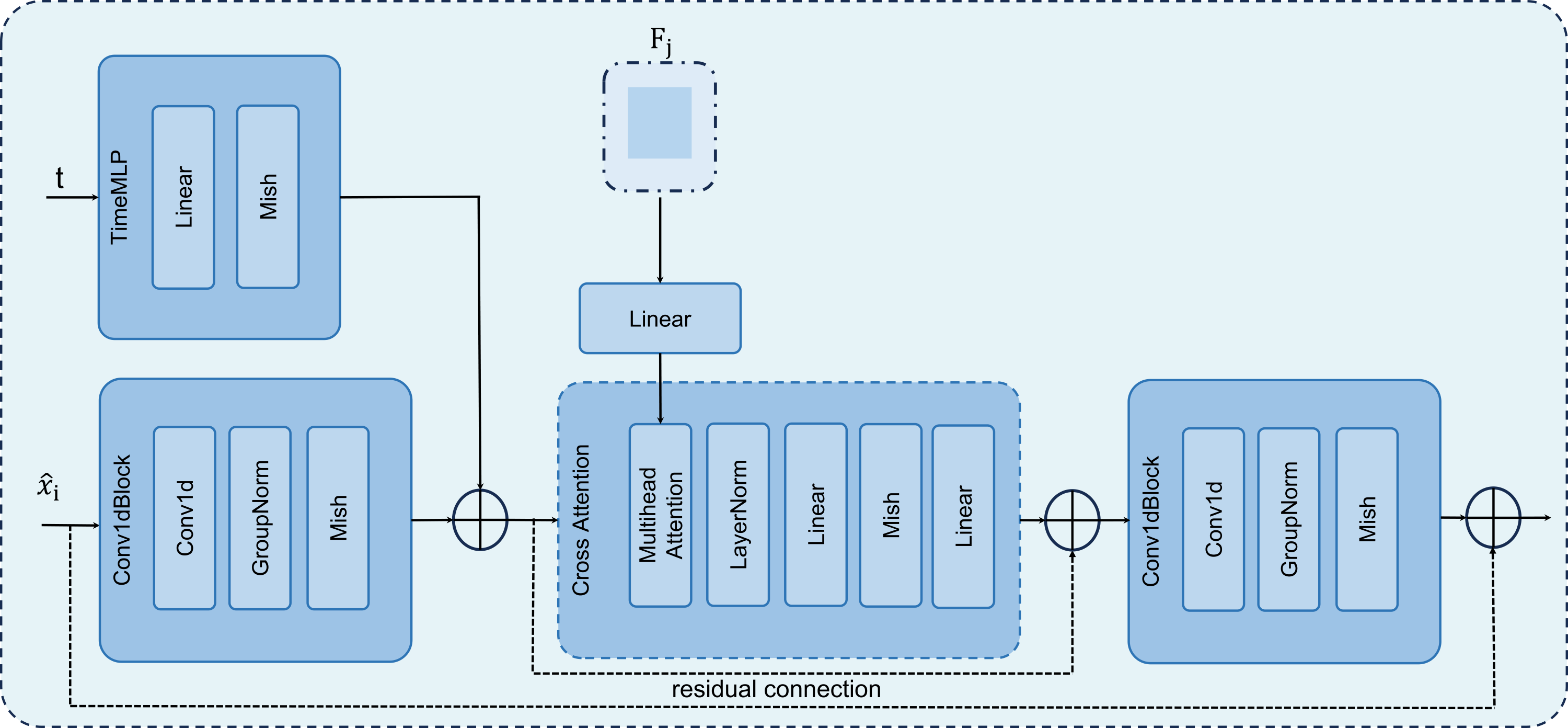
MTID generates learnable latent features between the encoded endpoints, refines their
temporal dependencies, and injects them directly into the action planner through cross-attention.
I
Latent mid-state guidance
Intermediate features are learned from the two observed endpoints without synthesizing pixels.
II
Task-aware initialization
The predicted task restricts initial action noise to the associated action vocabulary.
III
Endpoint-aware objective
A weighted masked loss emphasizes actions near the observed states and discourages irrelevant predictions.
Method
Three modules. Two training stages.
The task classifier is trained first. The latent interpolation module and diffusion planner
are then optimized together, so the generated guidance adapts to action reasoning.
01
Task prediction
Identify the task from both endpoints.
A Transformer classifier predicts the task from the start and goal observations.
The class conditions planning and defines the task-specific action mask.
02
Latent temporal interpolation
Construct visual guidance between states.
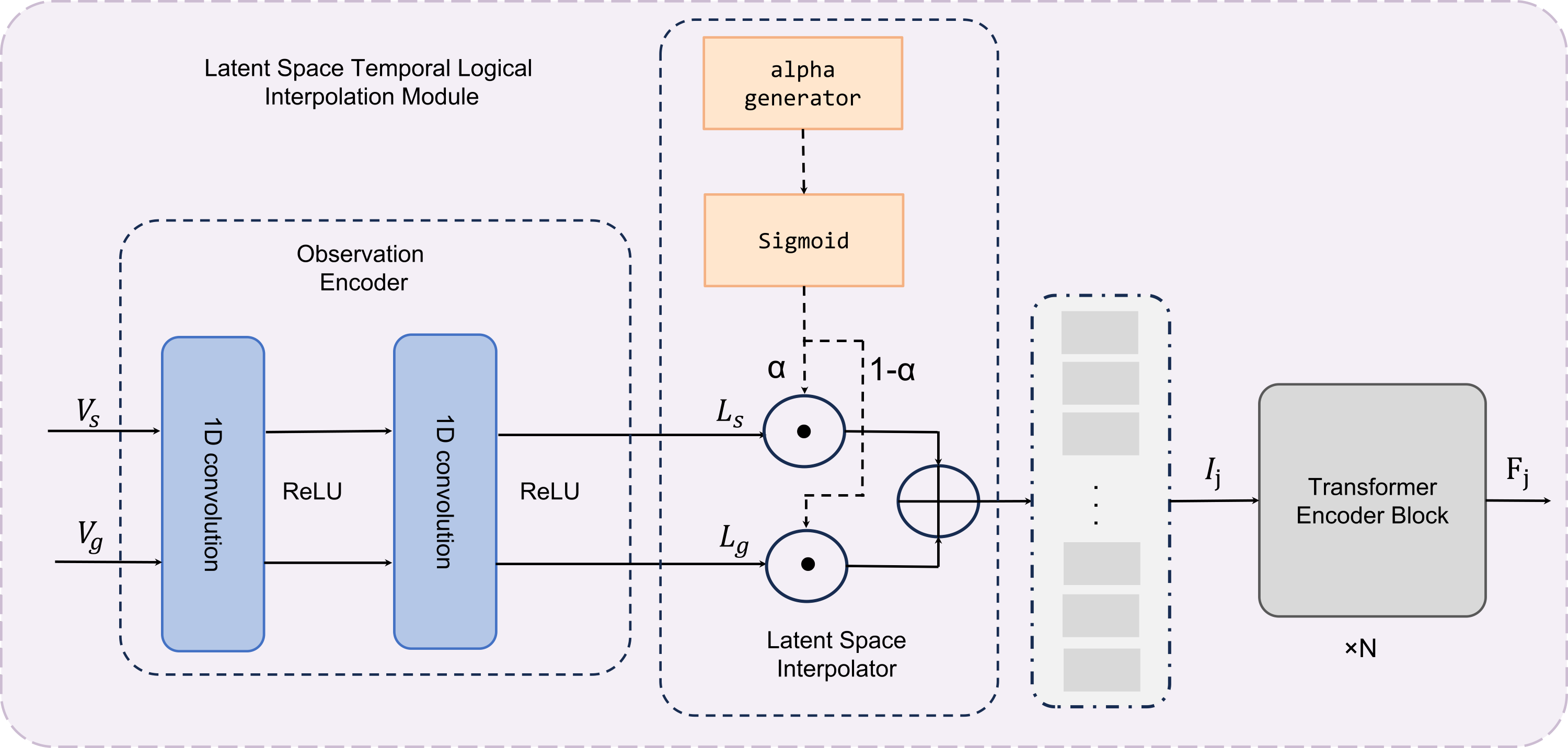
An observation encoder maps the endpoints to Ls and Lg.
Learnable interpolation weights generate intermediate features, which Transformer blocks refine.
Ij = (1 − φj)Ls + φjLg
03
Masked diffusion planning
Restrict first, then denoise jointly.
The task mask is applied to the initial action noise—not at every denoising iteration.
DDIM then denoises all T action steps jointly in a temporal U-Net.
Architecture details
See how interpolation and cross-attention connect
+
Open full resolution ↗Latent temporal interpolation. Encoded endpoints are mixed with learnable
weights and refined into F1:M.
Open full resolution ↗Cross-attention injection. Refined latent features condition residual
temporal blocks throughout the U-Net.
Selected results
Strong where the comparison is direct.
Values are percentage points. CrossTask uses HowTo100M features under the PDPP setting
for the dagger-marked rows in the paper’s main table.
CrossTask · T=3 · SR
40.45+1.52 over SCHEMA in Table 1
CrossTask · T=3 · mAcc
67.19+2.45 over KEPP in Table 1
CrossTask · main table
3best SR results across T=3–5
CrossTask
Success Rate across horizons
Higher is better
CrossTask Success Rate comparison across prediction horizons
Method
T=3
T=4
T=5
T=6
PDPP
37.20
21.48
13.45
8.41
KEPP
38.12
24.15
14.20
9.27
SCHEMA
38.93
24.50
14.75
10.53
MTID
40.45
24.76
15.26
10.30
MTID leads at T=3–5. At T=6, SCHEMA reports 10.53 versus MTID’s 10.30.
COIN & NIV · KEPP setting
Best SR and mAcc at T=4
COIN
180 tasks
22.74 SR
49.90 mAcc
NIV
5 tasks
24.89 SR
44.54 mAcc
mIoU is reported in the paper for completeness, but MTID is not the leading method on
mIoU in these tables; this page therefore avoids an across-the-board state-of-the-art claim.
Same-setting gain over PDPP · CrossTask T=3
+3.25 SR
Same-setting gain over PDPP · CrossTask T=3
+2.52 mAcc
Same-setting gain over PDPP · CrossTask T=3
+2.60 mIoU
Ablations
Three questions, tested separately.
The experiments isolate what to interpolate, when to apply the task mask, and how to
weight the objective. They are not presented as one cumulative ladder.
01
Interpolation design · T=3
Every module contributes
Interpolation only
37.86 SR
+ Observation encoder
39.23 SR
+ Transformer refinement
39.49 SR
Full stack
40.45 SR
02
Mask placement · T=3
Initialize once—do not clamp every step
No masked projection
39.17 SR
Mask at initialization
40.45 SR
Mask every iteration
3.38 SR
03
Training objective · T=5
Endpoint weighting drives the gain
MSE
11.89 SR
+ Gradient weighting
15.10 SR
+ Task mask
15.26 SR
Benchmarks & scope
Evaluated across three instructional-video datasets.
CrossTask2,750videos
18 tasks
105 action labels
7.6 average actions per video
COIN11,827videos
180 tasks
778 step types
3.6 average actions per video
NIV150videos
5 tasks
9.5 average actions per video
Longer instructional sequences
Evaluation protocol
Per-task 70 / 30 split
Videos are randomly split into 70% training and 30% testing within each task.
Results measure in-distribution procedure planning rather than unseen-task generalization.
Known dependency
Task errors can propagate
Planning depends on the predicted task and dataset-specific action vocabulary.
A task-class mismatch can therefore affect both conditioning and the action mask.
Output boundary
Action labels, not robot control
MTID predicts discrete benchmark actions from endpoint features. It is not a
video-generation model, deployed robot policy, or real-time control system.
Resources
Paper, code, and data.
Everything needed to read the work, inspect the implementation, and prepare the benchmark features.
If this work supports your research, please cite the ICLR 2025 paper.
BibTeX
@inproceedings{zhou2025masked,
  title     = {Masked Temporal Interpolation Diffusion for Procedure Planning in Instructional Videos},
  author    = {Yufan Zhou and Zhaobo Qi and Lingshuai Lin and Junqi Jing and Tingting Chai and Beichen Zhang and Shuhui Wang and Weigang Zhang},
  booktitle = {The Thirteenth International Conference on Learning Representations},
  year      = {2025},
  url       = {https://openreview.net/forum?id=HnpDHiItd2}
}